






Corporate Airbrush Event Planning: Staffing, Branding and Vendor Checklist
A live airbrush station turns merchandise into a personal keepsake while guests watch the artwork take shape. For a corporate planner, the important decisions are practical: how many people should receive an item, how long customization will run, what branding is approved and what the venue needs to provide. This checklist helps you build a clear brief before requesting a proposal from 3J's Airbrushing.
1. Start with the audience and the purpose
Choose one primary goal: an employee appreciation gift, a memorable client experience, a retail activation or a trade show giveaway. Set the number of intended recipients separately from total attendance. A conference with 1,000 attendees does not automatically need 1,000 customized items; a staff celebration with 150 guests may aim to serve every guest.
Match the merchandise to the audience and the event. Adjustable trucker hats simplify sizing, while shirts require a size assortment. Canvas bags offer another useful surface. Confirm who supplies the blanks, quantities, approved colors and delivery arrangements. Test customer-supplied merchandise before committing to a design.
2. Calculate staffing, then allow a practical buffer
For standard designs, 3J's uses approximately 25 customized items per artist per hour as a planning reference. Divide the target number of items by 25 and by the available customization hours to estimate the starting team size, then round up. The final plan must account for design complexity, breaks, guest questions and uneven demand.
For example, 100 items over three hours gives 100 ÷ 25 ÷ 3 = 1.33, so two artists are a sensible starting point. For 250 items over four hours, the same calculation gives 2.5, so start the staffing discussion at three artists. These are planning examples, not guaranteed output or a quoted package. Detailed artwork and shoe customization need a separate production estimate.
If most guests arrive during one short break, spreading the same work across a longer event does not solve the immediate queue. Consider a simpler menu, additional artists during the busy window or a clearly organized pickup process. 3J's can discuss teams from one to 16 artists, subject to availability and project requirements.
3. Approve the brand and personalization separately
Provide the company artwork, placement requirements and approved colors before the event. Identify which elements must remain consistent and where guests can choose a name, phrase or design. Ask how the logo will be applied and approve a physical or visual sample. Do not assume every brand mark can be reproduced accurately by freehand painting at event speed.
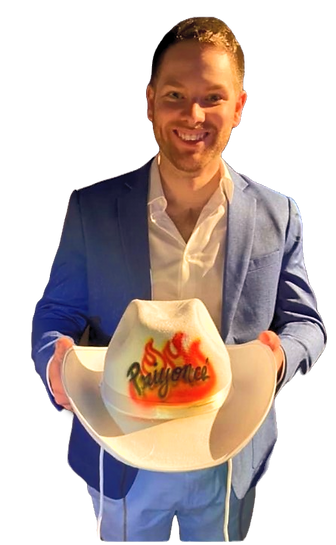
At Dreamforce in San Francisco on September 18, 2024, 3J's personalized trucker hats for DocuSign. The documented event shows how branded merchandise and individual customization can work together. Use that example to discuss your own artwork and guest choices; the photos do not establish a lead-generation or sales result.

4. Plan the space and guest flow
Discuss one or two tables and chairs per artist, nearby power and a layout that leaves room for guests and finished merchandise. Confirm the actual dimensions with the artist team and venue. Keep the design selection area, painting area and pickup area distinct. At a trade show, the exhibitor's lead collection should not obstruct the artists or the aisle.
Share the venue's load-in rules, access times, parking instructions, equipment restrictions and any surface-protection or ventilation requirements. For outdoor events, agree on shelter and a weather contingency. Identify an on-site contact who can resolve access and setup questions.
5. Coordinate procurement and multiple locations
Ask for a written scope that identifies artist count, customization hours, merchandise responsibilities, advance artwork preparation, travel and any shipping arrangements. 3J's can provide a W-9 and certificate of insurance on request. If the venue requires a specific insurance certificate, send its requirements early enough for review.
3J's work at Belk in Columbia and Charleston was part of projects across seven Belk locations. For a similar retail program, use a shared brief for design approval, merchandise, local contacts and operating hours while confirming each store's individual setup. Shoe artwork needs a different production plan from quick hat personalization.

6. Send a complete quote brief
Include the event date, city and venue, event type, expected attendance, target item count, merchandise choice, customization start and end times, branding needs and any procurement deadline. If you have a budget range, share it so the proposal can focus on a suitable combination of merchandise, design scope and staffing.
For employee celebrations, exhibitions, retail events and university programs, the strongest proposal starts with a realistic recipient count and approved design options. Ask the team to explain the assumptions behind its staffing recommendation before you finalize the scope.


Comments